
Artificial intelligence can write a response to a Google review in seconds.
For a busy business owner looking at a growing list of unanswered reviews, that sounds useful. But it raises an important question:
Does using AI to answer a customer review make the response less genuine?
It can—especially if software generates the response and publishes it without anyone at the business reading the review.
A customer took the time to describe an experience. If nobody pays attention before an automated response appears, the customer may reasonably conclude that the business did not listen.
That does not mean businesses need to reject AI altogether. The better question is how AI can reduce the writing workload without removing human attention, accountability, and judgment.
Key Takeaways
- Every review should be read and evaluated by a person.
- AI can help draft responses after that initial human review.
- A trained staff member or agency partner can approve routine responses using established business guidelines.
- Complaints and other sensitive situations should be escalated to the business owner or an authorized manager.
- Any response that could accept responsibility or create liability must be handled and approved directly by the business.
- Generic responses are a problem whether they were written by a person or generated by AI.
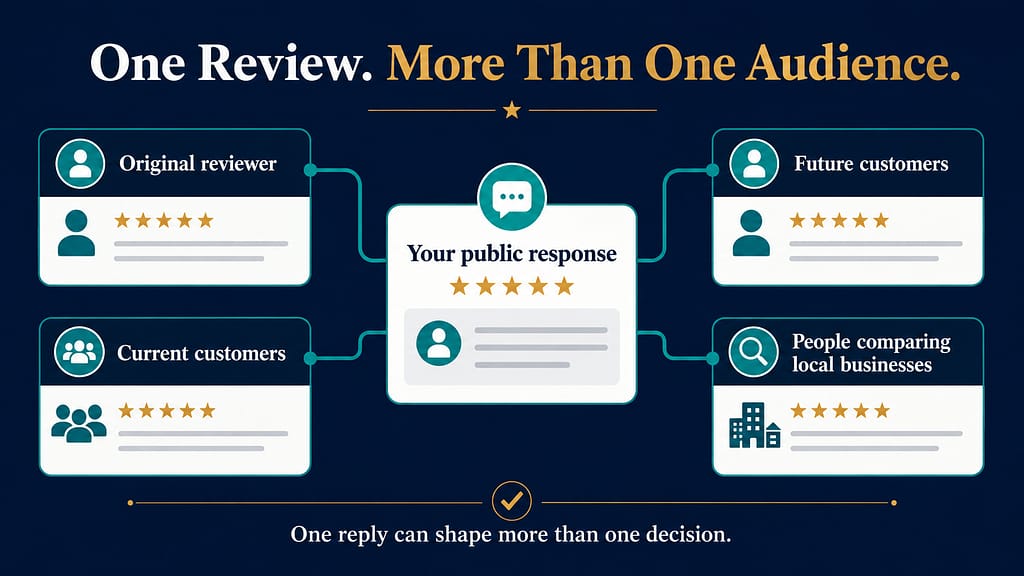
- Every response also speaks to potential customers who may read it later.
- The business remains responsible for every public response.
Why People Are Skeptical of AI Review Responses
Reviews are personal.
Someone had an experience with a business, formed an opinion, and publicly shared it. Customers want to believe that someone at the business actually read what they wrote.
That expectation becomes especially important when something went wrong.
I explained what happened, and nobody even bothered to read it.
If nobody did read the review, that reaction is justified.
The problem is not simply that AI helped write something. The problem is that the business removed human attention from a conversation that required it.
AI Can Still Help Produce a Better Response
Rejecting completely automated responses does not mean AI has no useful role.
People sometimes struggle to find the right words, particularly when they are busy, frustrated, or responding to similar reviews repeatedly. AI can help organize a response, identify details worth acknowledging, and suggest wording that sounds clear and professional.
The result can be better than something written hurriedly between phone calls, customer appointments, and other daily responsibilities.
AI can help with the writing. A person still needs to understand the review and take responsibility for the response.
Generic Is the Bigger Problem
Anyone who reads business reviews has seen responses like these:
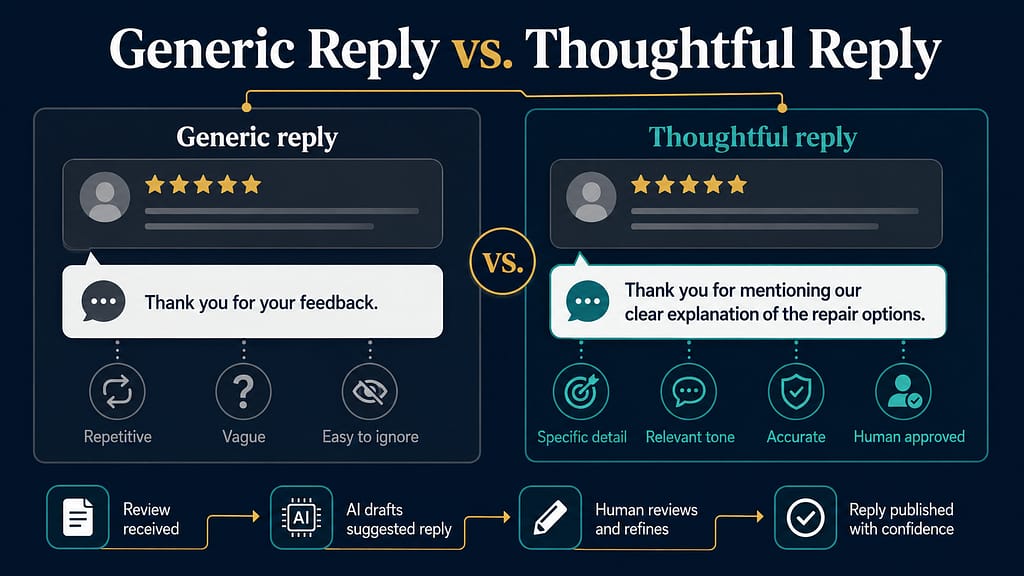
Thank you for your feedback.
We are sorry your experience did not meet expectations.
Thank you for the five-star review. We appreciate your business.
Those responses are not necessarily written by AI. People have copied and pasted generic templates for years.
A response is not automatically personal because a human typed it. An AI-assisted response is not automatically impersonal because software helped with the wording.
Google’s official guidance recommends keeping replies clear, helpful, polite, relevant, and conversational. Google also warns businesses against repeatedly sending the same generic thank-you message.
The final response should demonstrate that the business understood what the customer said.
AI-Assisted Is Different From AI-Automated
Imagine that a new review arrives. Software reads it, generates a response, and publishes that response immediately.
Nobody at the business reads the review. Nobody checks whether the response is accurate. Nobody determines whether the customer raised a problem requiring attention. Nobody accepts responsibility for what the business says publicly.
We would not recommend that process.
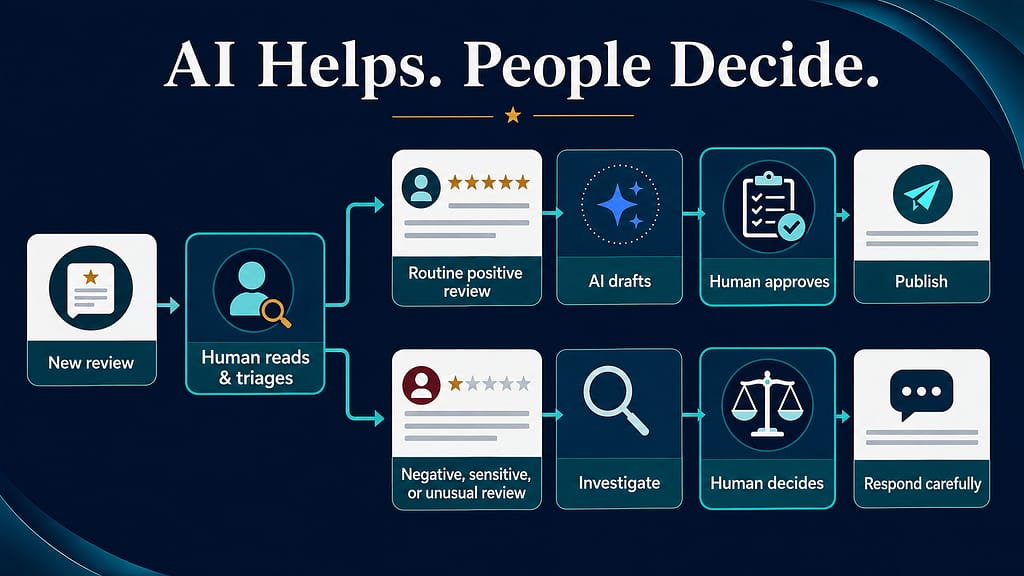
Now consider a five-star review from a satisfied customer. A person reads the review and confirms that it does not contain a complaint or another concern requiring follow-up. AI then helps prepare a personalized draft. A trained person checks the wording and approves the response.
AI reduces the writing workload. It does not control the customer relationship.
Why Use AI at All?
Responding thoughtfully to reviews takes time.
Business owners are also serving customers, answering phones, managing employees, handling schedules, ordering supplies, solving problems, and doing the work that keeps the business operating.
Review responses matter, but they are easy to postpone.
After someone reads and classifies a routine review, AI can help by:
- identifying details worth acknowledging;
- suggesting personalized language;
- providing different tone options;
- reducing repetitive phrasing;
- creating a concise first draft; and
- helping someone get past the blank page.
A trained person then checks the draft and decides what gets published.
Negative Reviews Need a Different Process
A meaningful negative review deserves human attention before anyone begins drafting a response.
The first question should not be:
What should we reply?
The business should first ask:
- What happened?
- Is the complaint accurate?
- Do we need more information?
- Does something inside the business need to be corrected?
- Who should be involved before we respond publicly?
- Would a private conversation be more appropriate?
Only after considering those questions should the business decide what to say.
AI may still help as a thinking or writing tool. It can suggest possible approaches, identify defensive wording, or provide language for someone to consider. In some situations, the best decision will be to discard those suggestions and write the response entirely by hand.
The business may need to investigate, speak with an employee, protect private information, involve an owner or manager, or contact the customer directly. A writing tool cannot make those decisions responsibly on its own.

A Negative Review Is Not Just a Writing Problem
A negative review may contain information the business needs.
The complaint may be unreasonable or based on a misunderstanding. The reviewer may have omitted important facts. The customer may also be right.
If every negative review immediately enters a system whose only purpose is to generate a polite answer, the business may start treating the response as the problem instead of examining the experience that caused the review.
The response matters, but the business itself matters more.
Effective Google review management for local businesses includes protecting the business’s public reputation while recognizing when customer feedback reveals a service, communication, staffing, or operational problem worth correcting.
What Is Google’s Position on AI-Assisted Review Responses?
Google’s published Business Profile guidance does not currently say that a business is prohibited from using AI to help draft a review response.
Google places responsibility for the public reply on the business managing the profile. The profile manager opens the review, enters a reply, and submits it. Google then checks the reply for compliance with its content policies before publishing it under the business’s name.
Google’s guidance focuses on the quality and content of the final response. Replies should be useful, relevant, polite, conversational, and free from private information or promotional language.
That makes the business responsible for what gets published, regardless of which person or tool helped prepare the draft.
The key is not whether AI helps draft the response. The key is whether the response is reviewed with human judgment before it goes live.
For routine reviews, that review can be handled by a trained staff member or an agency partner working from approved business guidelines.
More sensitive reviews—including complaints, refund disputes, employee concerns, safety problems, legal threats, and other unusual situations—must be escalated directly to the business owner or an authorized manager. Any response that could admit fault, accept responsibility, promise compensation, address a legal or safety issue, or otherwise create liability must be written or expressly approved by the business. An agency partner may identify and escalate the issue, but should not decide or publish that response on the business’s behalf.
The Person Reading the Response Is Not Only the Reviewer
A business is also responding to everyone who may read the exchange later.
Someone searching for a contractor, dentist, retailer, salon, restaurant, repair shop, or another local business may read both the customer’s review and the business’s response before deciding whom to contact.
A thoughtful response can demonstrate professionalism and care. A defensive response can do the opposite. An unanswered complaint leaves potential customers with only one side of the story.
Review management is therefore part of the business’s public reputation and customer-acquisition process, not simply another administrative task.
Our Position: AI Should Assist the Work, Not Replace Human Judgment
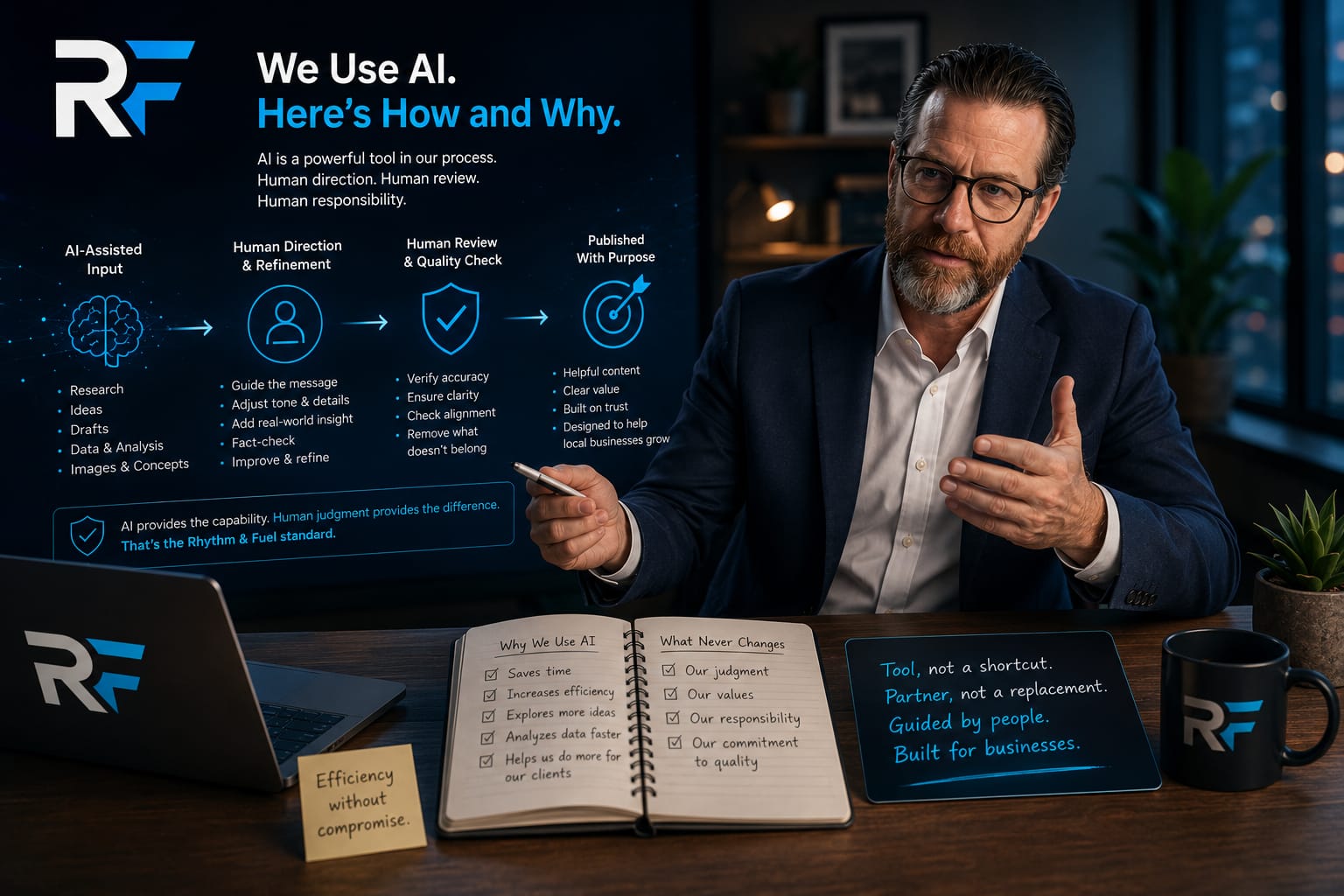
At Rhythm & Fuel, we use AI. We also do not believe that automatically answering every review is responsible reputation management.
Every review first receives human attention.
After that initial review, AI can help with drafting, consistency, personalization, and the workload involved in routine responses. A trained person still determines what gets published.
When a review raises a complaint, sensitive issue, or unusual situation, the process changes. Human understanding moves to the front. AI may help evaluate tone, provide ideas, or stay out of the final response entirely.
Technology should make it easier for a business to pay attention to its customers. It should not become an excuse to stop paying attention to them.
So, Should Businesses Use AI to Respond to Google Reviews?
Yes—when it is used responsibly and selectively.
Use AI to reduce repetitive work, get past the blank page, and personalize routine responses. Use it to explore possible wording when someone is unsure how to approach a reply.
Do not send every review through the same automated process.
Someone still needs to read the review, understand what the customer said, recognize when the situation requires investigation, and accept responsibility for what the business says publicly.
The goal is not to make AI sound human. The goal is to use helpful technology without removing the human judgment that reputation management requires.
Need Help Keeping Up With Your Google Reviews?
If responding to reviews keeps falling to the bottom of your list, Rhythm & Fuel can help.
We help businesses in Santa Maria, Orcutt, and across California’s Central Coast manage their Google presence through practical systems for review management, review growth, Google Business Profile optimization, and ongoing local visibility.
For routine reviews, AI can help us work efficiently while trained people review what gets published. When a review raises a complaint or another sensitive issue, we slow the process down and give the situation the attention it requires.
Want to discuss what that process could look like for your business?