
A negative Google review can create pressure to respond immediately. The business may want to defend itself, correct the record, or ask Google to remove the review. But the safest first step is not writing. It is understanding what happened and choosing the right path before anything is posted publicly.
A negative review may point to a customer-service issue, a misunderstanding, a policy question, a privacy concern, or a review that violates Google’s content policies. The best next step depends on the facts and on what the business needs to do next.
Key Takeaways
- Read the review carefully before deciding what to say.
- Separate the customer’s claims from the facts you can verify.
- Decide whether the business needs to investigate or fix something before replying.
- Move sensitive details away from the public review whenever possible.
- Report a review when it appears to violate Google’s policies, but do not assume every unfair or negative review will be removed.
- Escalate complaints involving privacy, safety, legal threats, refunds, employees, or disputed facts.
A Negative Review Is Not Just a Writing Problem
When a negative review arrives, it is tempting to focus immediately on wording. Should the response apologize? Should it explain the business’s side? Should it challenge the reviewer? Should it ask the person to call?
Those questions matter, but they come after a more basic question: what happened?
A review may describe a real problem. It may describe a misunderstanding. It may leave out important details. It may come from someone who was never a customer. Or it may contain private, abusive, or otherwise prohibited material.
A polished response cannot replace the work of understanding the situation. Before drafting, the business should decide whether the review reveals something that needs attention inside the business.
Step 1: Read the Review Carefully
Read the entire review, not just the star rating or the most emotional sentence. Look for specific details: the date, service, product, location, employee, or event the reviewer mentions.
Do not assume that a harsh tone means every detail is false. Do not assume that a calm tone means every detail is accurate. The first job is to understand what the reviewer is claiming.
Step 2: Ask Four Questions Before Drafting
Before anyone writes a response, ask four questions:
- Is this person likely describing a real customer interaction?
- What specific issue are they raising?
- What does the business know?
- What does the business still need to investigate?
These questions keep the team from treating every review as either completely true or completely false.
Step 3: Separate Facts From Assumptions
Write down what the business can verify and what remains uncertain. Check the information that is appropriate for the people who need to know, such as appointment records, order details, employee notes, or the manager’s account of what happened.
Avoid putting private customer information, employee information, account details, or internal explanations into a public reply. A public review response is not the place to prove everything the business knows.
Step 4: Decide Whether Something Needs to Be Fixed
A review may identify a service problem, communication failure, scheduling issue, billing concern, or employee matter. If the business needs to investigate or correct something, do that work before treating the public response as finished.
The response is only one part of reputation management. The business also has to decide what it will do differently, if anything, after hearing the complaint.
Step 5: Choose the Right Conversation Path
Not every situation belongs entirely in a public reply. A short public response may acknowledge the concern and invite the reviewer to continue privately. That can show future customers that the business is paying attention without exposing private details.
A private conversation is especially important when the review involves personal information, a refund, an employee, a health or safety concern, a legal threat, or facts that cannot be responsibly discussed in public.

Step 6: Decide Whether the Review Should Be Reported
Google provides a process for reporting reviews that violate its policies. Examples may include prohibited content, conflicts of interest, fake or deceptive activity, personal information, harassment, or other policy violations.
Reporting a review is different from disagreeing with it. A review can be unfair, frustrating, or damaging without automatically violating Google’s rules. The business should use Google’s reporting process when there is a policy-based reason, not simply because the review is negative.
Google guidance on managing customer reviews
Google guidance on reporting inappropriate reviews
Google Maps prohibited and restricted content
When a Negative Review Needs Escalation
Some reviews should not go through a routine reply workflow. Escalate when the review involves:
- A disputed account of what happened.
- A refund, charge, or billing dispute.
- An employee accusation or employment matter.
- A privacy, health, or safety concern.
- A legal threat or possible admission of fault.
- Harassment, discrimination, or threats.
- A situation where the business does not yet know the facts.
In these cases, the goal is not to produce the fastest sentence. The goal is to make a responsible decision about what the business should say, what it should do, and who should approve the response.
Need a clearer process for difficult reviews?
Rhythm & Fuel helps local businesses build review-management systems that define who monitors reviews, when the business responds, when a matter is escalated, and when an outside partner may assist with routine replies under approved guidelines. We can help organize facts, advise on next steps, and support the workflow without automatically taking over every negative review. Schedule a conversation with Rhythm & Fuel.
What a Public Response Should Avoid
- Arguing point by point with the reviewer.
- Sharing private customer or employee information.
- Making promises the business may not be able to keep.
- Admitting fault before the facts are understood.
- Threatening the reviewer or accusing them of lying.
- Copying the same generic response used for every complaint.
- Promoting the business as if the negative review were an advertisement.
What a Useful Response Can Do
When a public response is appropriate, it should be calm, relevant, and specific enough to show that the business understood the concern. It can acknowledge the experience, avoid private details, explain the next private step, and make it clear how the reviewer can contact the business.
Google’s guidance encourages businesses to write helpful replies and explains that businesses can report reviews that violate Google’s policies. The practical lesson is simple: respond to legitimate customer feedback with judgment, and use the reporting process for policy violations.
Google tips for getting and responding to reviews
A Simple Decision Rule
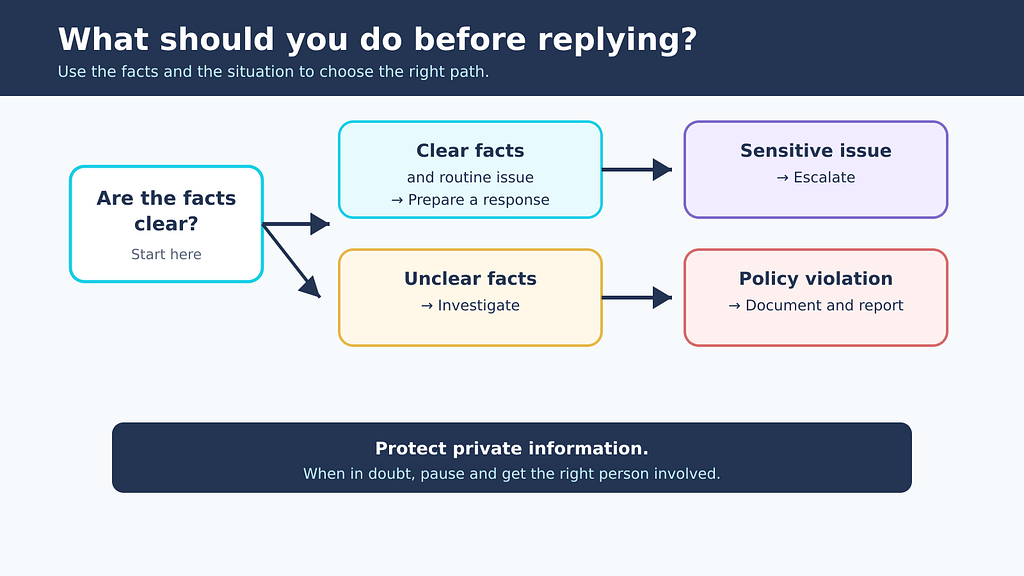
If the facts are clear and the issue is routine, a trained person can usually prepare a calm public response. If the facts are unclear, investigate before replying. If the matter is sensitive, escalate it. If the review appears to violate Google’s policies, document the reason and report it through Google’s process. This decision rule is more reliable than using the same response formula for every negative review.
Frequently Asked Questions
Should I respond to every negative Google review?
Not necessarily in the same way or on the same timeline. Legitimate customer feedback generally deserves thoughtful attention, but a sensitive or disputed review may need investigation or escalation before a public response. A review that appears to violate Google’s policies may be reported instead of handled as ordinary feedback.
What should I do before replying to a bad review?
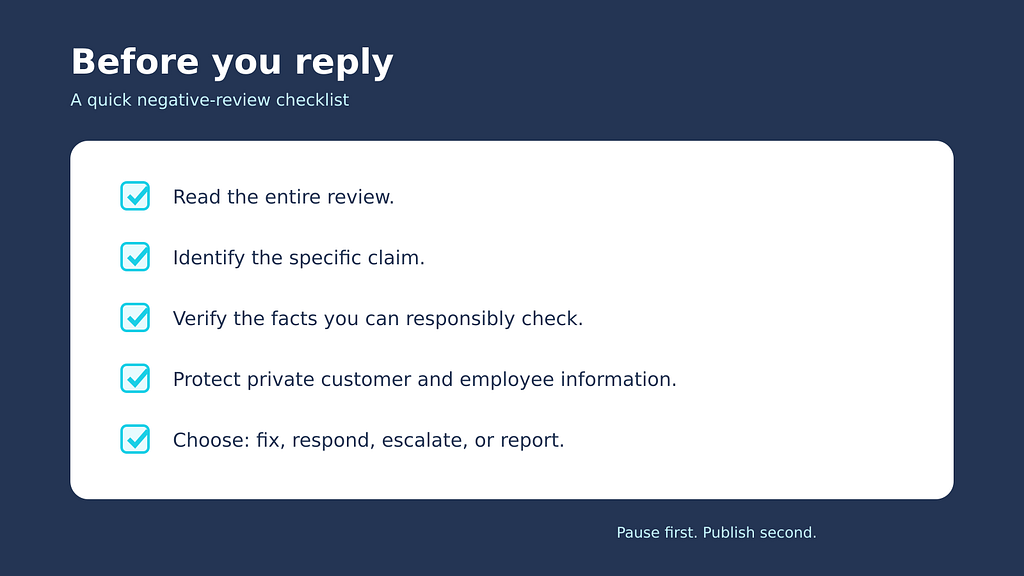
Read the full review, identify the specific claim, verify the facts you can responsibly check, decide whether the business needs to fix something, and determine whether the matter should be handled privately, escalated, or reported.
Can I ask Google to remove an unfair review?
You can report a review when you believe it violates Google’s content policies. However, being unfair, harsh, or negative does not automatically mean a review is removable. The report should be based on a policy reason, not simply disagreement with the reviewer.
Should I use AI to write a response to a negative review?
AI can help organize information or suggest wording after a person has reviewed the original complaint and confirmed the relevant facts. It should not invent details, expose private information, decide who is right, or publish an unchecked response.
How Review Management Makes This Easier
A business does not need a complicated system, but it does need agreed rules. A useful review-management process identifies who monitors reviews, how routine reviews are handled, which situations require escalation, who can approve a sensitive response, and how the business records follow-up.
That is where human-reviewed AI assistance can help with routine work. AI may help organize information or suggest wording after a person has read the review. It should not decide what happened, invent facts, expose private information, or publish an unchecked response.
For a broader look at the service itself, see Google Review Management for Local Businesses.
Need Help Building the Process?
Negative reviews are easier to handle when the business has a defined process before the next difficult review arrives. Rhythm & Fuel helps local businesses in Santa Maria, Orcutt, and across California’s Central Coast with Google Business Profile optimization, review management, review growth, and ongoing visibility.
If you want to discuss what a practical review-management process could look like for your business, schedule a conversation with Rhythm & Fuel.